Find maritime knowledge
Knowledge
Keyword: innovation
A High-order Accurate Spectral Element-based Time-Domain Simulation of a Model-Scale Floating Offshore Wind Turbine
This paper describes a new high-order composite numerical model for simulating moored floating offshore bodies. We focus on a floating offshore wind turbine and its static equilibrium and free decay. The composite scheme models linear to weakly nonlinear motions in the time domain by solving the Cummins equations. Mooring forces are acquired from a discontinuous Galerkin finite element solver. Linear hydrodynamic coefficients are computed by solving a pseudo-impulsive radiation problem in three dimensions using a spectral element method. Numerical simulations of a moored model-scale floating offshore wind turbine were performed and compared with experimental measurements for validation, ultimately showing a fair agreement.
A hybrid linear potential flow – machine learning model for enhanced prediction of WEC performance
Linear potential flow (LPF) models remain the tools-of-the-trade in marine and ocean engineering despite their well-known assumptions of small amplitude waves and motions. As of now, nonlinear simulation tools are still too computationally demanding to be used in the entire design loop, especially when it comes to the evaluation of numerous irregular sea states. In this paper we aim to enhance the performance of the LPF models by introducing a hybrid LPF-ML (machine learning) approach, based on identification of nonlinear force corrections. The corrections are defined as the difference in hydrodynamic force (viscous and pressure-based) between high-fidelity CFD and LPF models. Using prescribed chirp motions with different amplitudes, we train a long short-term memory (LSTM) network to predict the corrections. The LSTM network is then linked to the MoodyMarine LPF model to provide the nonlinear correction force at every time-step, based on the dynamic state of the body and the corresponding forces from the LPF model. The method is illustrated for the case of a heaving sphere in decay, regular and irregular waves – including passive control. The hybrid LPF model is shown to give significant improvements compared to the baseline LPF model, even though the training is quite generic.
A stabilised nodal spectral element method for fully nonlinear water waves
We present an arbitrary-order spectral element method for general-purpose simulation of non-overturning water waves, described by fully nonlinear potential theory. The method can be viewed as a high-order extension of the classical finite element method proposed by Cai et al. (1998)[5], although the numerical implementation differs greatly. Features of the proposed spectral element method include: nodal Lagrange basis functions, a general quadrature-free approach and gradient recovery using global L2projections. The quartic nonlinear terms present in the Zakharov form of the free surface conditions can cause severe aliasing problems and consequently numerical instability for marginally resolved or very steep waves. We show how the scheme can be stabilised through a combination of over-integration of the Galerkin projections and a mild spectral filtering on a per element basis. This effectively removes any aliasing driven instabilities while retaining the high-order accuracy of the numerical scheme. The additional computational cost of the over-integration is found insignificant compared to the cost of solving the Laplace problem. The model is applied to several benchmark cases in two dimensions. The results confirm the high order accuracy of the model (exponential convergence), and demonstrate the potential for accuracy and speedup. The results of numerical experiments are in excellent agreement with both analytical and experimental results for strongly nonlinear and irregular dispersive wave propagation. The benefit of using a high-order – possibly adapted – spatial discretisation for accurate water wave propagation over long times and distances is particularly attractive for marine hydrodynamics applications.
Åben Innovation i Det Blå Danmark. På trods af DNA og NDA
ADVANTAGES AND LIMITATIONS OF USING CAMERAS ON SMALL, LOW-COST ROVS FOR SEABED MONITORING
Monitoring methods, such as seabed bottom-towed cameras, sediment grabs, and benthic sledges, have limitations in spatial coverage, cause seabed disturbance, are restricted to soft-bottom substrates, and offer low flexibility for marine seabed monitoring. In this study, we investigate the potential of a non-invasive and simple underwater remotely operated vehicle (ROV) to enhance marine seabed monitoring. A tethered ROV equipped with a GoPro camera was deployed in three areas of Skagerrak at depths from 15-34 m to assess accuracy in species identification and substrate classification identified from still frames. The quality of still frames varied between areas due to turbidity, motion blur, and marine snow, which reduced the number of high-quality frames by approximately 20%. Classification of substrates and taxa identification were possible in the remaining still frames. Two different substrates were detected: sand and stone reef. Stone reefs had a lower occurrence compared to sand. A total of 10 taxa were detected in the two substrate types. The highest abundance was observed in the stone reef substrate compared to the sand substrate. Identification at the species level was limited due to the quality of the still frames, which affected the detectability of morphological traits. This study demonstrates that a widely accessible ROV can be used for marine monitoring. The ROV can be used in different substrates, and still frames provide valuable information on species composition, which can enhance the replicability of monitoring programs.
Anticipated innovations for the blue economy: Crowdsourced predictions for the North Sea Region
The mission policy approach to the sustainable blue economy has identified as critical the ability to anticipate the emergence of a wide range of feasible innovations as they enter the transactional environment of organizations in the marine and maritime sector. This article contributes to that growing effort by harnessing the wisdom of the crowd and presents more than 60 crowdsourced, time-specific innovation forecasts expected to impact maritime, shipbuilding, ports, offshore wind, and ocean infrastructure. Data were collected in 2020 by the EU-funded Interreg VB PERISCOPE Project, a North Sea Region initiative to catalyze transregional innovation. The results can be used strategically to develop collaborative, transregional planning and policy for innovation based on data reflecting public expectations for the future. Years from now, this article can also act as a snapshot of public expectations at the onset of the decade.
Attenuation Capacity of a Multi-Cylindrical Floating Breakwater
Floating breakwaters (FBs) are frequently used to protect marinas, fisheries, or other bodies of water subject to wave attacks of moderate intensity. New forms of FBs are frequently introduced and investigated in the literature as a consequence of technological advancements. In particular, a new possibility is offered by High-Density Polyethylene (HDPE) by extruding pipes of large diameters (e.g., 2.5 m in diameter) and with virtually no limit in length (hundreds of meters). By connecting two or three such pipes in a vertical layout, a novel low-cost floating breakwater with deep draft is devised. This note investigates numerically and experimentally the efficiency of this type of multi-cylindrical FBs in evaluating different geometries and aims at finding design guidelines. Due to the extraordinary length of the breakwater, the investigation is carried out in two dimensions. The 2D numerical model is based on the solution of the rigid body motion in the frequency domain, where the hydrodynamic forces are evaluated (thanks to a linear potential flow model), and the mooring forces do not include dynamic effects nor drag on the lines. The numerical predictions are compared to the results of a 1:10 scale experimental investigation. An atypical shape of the wave transmission (𝑘𝑡) curve is found, with a very low minimum in correspondence with the heave resonance frequency. The results essentially point out the influence of the position of the gravity center, the stiffness, and the mutual distance among cylinders on 𝑘𝑡.
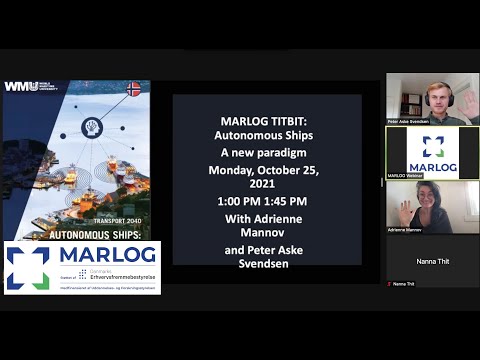
Autonomous Ships: A new paradigm for Norwegian shipping
In this webinar, Adrienne Mannov from Aarhus University and Peter Aske Svendsen from NFA presented their research on autonomous shipping as this relates to seafaring and technology, based on their 2019 report, “Transport 2040: Autonomous ships: A new paradigm for Norwegian shipping - Technology and transformation”.
The event was organized in collaboration with MARLOG
Business ecosystems and the view from the future: The use of corporate foresight by stakeholders of the Ro-Ro shipping ecosystem in the Baltic Sea Region
Ecosystems are viewed as important sources of innovation. While contracts, rules, policies, and industrial standards have been identified as important for coordinating and aligning inter-firm relationships, tools for the collective, collaborative orchestration of ecosystems have yet to be fully identified and articulated by scholars. The core contribution of this paper, the authors contend, is that corporate foresight tools, as applied at the level of the ecosystem, have the potential to orchestrate ecosystems. To this end, the authors examine the practical use of corporate foresight tools, in this case, roadmapping and scenario planning, as employed by ECOPRODIGI, an Interreg Baltic Sea project designed to advance the EU's strategy for eco-efficient Sustainable Blue Economy in the Roll-on/Roll-off (Ro-Ro) shipping ecosystem. Results demonstrate how ecosystem-level foresight significantly differs from traditional foresight centered around a focal firm. Corporate foresight tools, as applied to an ecosystem: 1) Target a diverse set of ecosystem actors beyond the segment's focal firm, including complementary firms, investors, and non-market actors; 2) Engage ecosystem actors, rather than only the focal firm, in shared strategy development based on a diverse mix of foresight tools; and 3) serve to orient and reify the ecosystem by charting the collective anticipation of innovations, policies, etc., in a shared set of future options. In the end, the authors find that corporate foresight tools operate as constitutive elements of ecosystems, that is, the tools help enact the ecosystem not as an abstract concept but as a shared, lived reality.
Challenges in Modeling and Control of Offshore De-oiling Hydrocyclone Systems
Offshore de-oiling installations are facing an increasing challenge with regards to removing oil residuals from produced water prior to discharge into the ocean. The de-oiling of produced water is initially achieved in the primary separation processes using gravity-based multi-phase separators, which can effectively handle large amounts of oil-well fluids but may struggle with the efficient separation of small dispersed oil particles. Thereby hydrocyclone systems are commonly employed in the downstream Produced Water Treatment (PWT) process for further reducing the oil concentration in the produced water before it can be discharged into the ocean. The popularity of hydrocyclone technology in the offshore oil and gas industry is mainly due to its rugged design and low maintenance requirements. However, to operate and control this type of system in an efficient way is far less simple, and alternatively this task imposes a number of key control challenges. Specifically, there is much research to be performed in the direction of dynamic modeling and control of de-oiling hydrocyclone systems. The current solutions rely heavily on empirical trial-and-error approaches. This paper gives a brief review of current hydrocyclone control solutions and the remaining challenges and includes some of our recent work in this topic and ends with a motivation for future work.