Find maritime knowledge
Knowledge
Keyword: green shipping
A Comeback of Wind Power in Shipping: An Economic and Operational Review on the Wind-assisted Ship Propulsion Technology
Wind-assisted ship propulsion (WASP) technology seems to be a promising solution toward accelerating the shipping industry’s decarbonization efforts as it uses wind to replace part of the propulsive power generated from fossil fuels. This article discusses the status quo of the WASP technological growth within the maritime transport sector by means of a secondary data review analysis, presents the potential fuel-saving implications, and identifies key factors that shape the operational efficiency of the technology. The analysis reveals three key considerations. Firstly, despite the existing limited number of WASP installations, there is a promising trend of diffusion of the technology within the industry. Secondly, companies can achieve fuel savings, which vary depending on the technology installed. Thirdly, these bunker savings are influenced by environmental, on-board, and commercial factors, which presents both opportunities and challenges to decision makers.
A framework for multi-objective optimization of hybrid energy storage in integrated multi-energy systems at mega seaports
Seaports consume a large amount of energy and emit greenhouse gas and pollutants. Integrated multiple renewable energy systems constitute a promising approach to reduce the carbon footprint in seaports. However, the intermittent nature of renewable resources, stochastic dynamics of the demand in seaports, and unbalanced structure of seaport energy systems require a proper design of energy storage systems. In this paper, a framework for multi-objective optimization of hybrid energy storage systems in stochastic unbalanced integrated multi-energy systems at sustainable mega seaports is proposed to minimize life-cycle costs and minimize carbon emissions. The optimization problem is formulated with reference to the energy management of the integrated multi-energy system at the seaport and considering both distributed and centralized hybrid energy storage configurations. Wavelet decomposition and double-layer particle swarm optimization are proposed to solve the multi-objective optimization problem. The real power system of the largest port worldwide, i.e., the Ningbo Zhoushan Port, was selected as a case study. The results show that, with respect to a situation with no energy storage system, the proposed approach can save 81.29 million RMB in electricity purchases and eliminate approximately 497,186 tons of carbon emissions over the entire lifecycle of the energy storage system. The findings suggest that the proposed hybrid energy storage framework holds the potential to yield substantial economic and environmental advantages within mega seaports. This framework offers a viable solution for port authorities seeking to implement hybrid energy storage systems aimed at fostering greater sustainability within port operations.
A hierarchical multi-objective co-optimization framework for sizing and energy management of coupled hydrogen-electricity energy storage systems at ports
Hydrogen-electricity integrated multi-energy systems are promising approaches to reduce carbon emissions in ports. However, the stochastic nature of renewable energy and the imbalance between the renewable generation and load demand in ports necessitate the design of an appropriate coupled hydrogen-electricity energy storage systems (CHEESS). This paper proposes a multi-objective optimization model for CHEESS configuration in random unbalanced port integrated multi-energy systems (PIMES), aiming to minimize its life-cycle cost and carbon emissions through co-optimization of sizing and energy management. A hierarchical two-stage framework is proposed to solve the multi-objective model. The proposed optimization framework is applied to a real PIMES at the Ningbo-Zhoushan Port. The results show that the proposed method can save 10.54% of the monetary cost and 19.67% of carbon emissions over the entire life-cycle of the system. The study demonstrates that the proposed framework has the potential to generate significant economic and environmental benefits and provides a feasible solution for port authorities seeking to implement CHEESS, aiming to promote sustainability in port operations.
A hybrid multi-criteria dynamic sustainability assessment framework for integrated multi-energy systems incorporating hydrogen at ports
Port Integrated Multi-Energy Systems (PIMES) play a critical role in advancing sustain-ability at ports. Assessing the dynamic contribution of PIMES to port sustainability is essential for guiding future developments. This research introduces an innovative multi-criteria dynamic sustainability assessment framework tailored to evaluate the performance of PIMES. The framework employs a diverse set of indicators covering multiple criteria to comprehensively assess different aspects of PIMES. A game theory-based combined weighting approach is uniquely applied to integrate subjective and objective evaluations, ensuring a balanced and robust assessment. Furthermore, the cloud model is utilized for an in-depth evaluation of the overall sustainability of PIMES, offering a novel perspective on managing uncertainty. The framework's applicability and effectiveness are demonstrated through a case study of the Ningbo-Zhoushan Port, with a sensitivity analysis of the indicators conducted to enhance reliability and confirm the robustness of the proposed method. The evaluation results indicate that during the development of the PIMES, the sustainability performance of the studied port improves progressively, with ratings of “average”, “poor”, “average”, “average”, “good”, and “excellent”. The sensitivity analysis shows that the sustainability of ports is most influenced by the failure loss rate and operation & maintenance cost of PIMES. This framework can serve as a decision-making tool for port authorities to enhance energy efficiency, reduce emissions, and achieve long-term sustainability objectives at ports.
Analyzing inland waterway competitiveness with electric autonomous RoRo vessels: A case study from Rotterdam to Ghent
Adopting green vehicles in the transport sector is a highly effective policy for mitigating the sector’s carbon footprint. Moreover, the EU transport policy acknowledges the pivotal role of inland waterways (IWW) in decarbonizing Europe, with a strategic objective to enhance its modal share through the transition from road to IWW. This paper investigates the potential of electric autonomous Roll-on Roll-off (RoRo) ships to enhance the competitive edge of IWW as compared to road transport. This paper examines the impact of this innovative transport system on sustainability by analyzing Key Performance Indicators (KPIs) across economic and environmental dimensions using a comparative case study approach and quantitative analysis data. The main result is that implementing electric autonomous RoRo ships can lead to a 45 % reduction in OPEX (operational expenditure), with profitability expected after about 3.5 years. Emissions decrease by more than 60 %, and by 2030, CO2 emissions in the Well-to-Wake (WTW) cycle are projected to reduce by approximately 77,000 tonnes, aligning with EU transport and environmental policies.
Automated recognition and length estimation of fish on fishing vessels
Cod stocks in the Danish inland waters and the Baltic Sea have collapsed today. Fishing vessels have therefore been required to install video cameras that film the catch for control purposes. The use of artificial intelligence for automated documentation of the catch is therefore a promising solution for control as well as research and management purposes that can contribute to rebuilding cod stocks and ensuring sustainable fishing in the future.
Cost–benefit analysis and design optimization of wind propulsion systems for a Tanker retrofit case
This study introduces WindWise, a cost–benefit analysis and design optimization tool for Wind Propulsion Systems (WPS) in sustainable shipping. By integrating route simulations, ship constraints, and fuel pricing scenarios, WindWise determines the optimal WPS configuration to maximize fuel savings and minimize payback periods. A retrofit case study of an oil tanker evaluates two WPS classes—DynaRigs and Rotor Sails—across multiple operational and economic conditions. Results reveal that optimal configurations vary based on constraints: in an unconstrained scenario, larger, well-spaced installations minimize aerodynamic losses, whereas realistic constraints shift the preference towards smaller, distributed setups to mitigate cargo loss and air draft penalties. Rotor Sails offer lower upfront costs and shorter payback periods for modest savings targets and for side-wind routes, while DynaRigs emerge as the more viable solution for higher emissions reductions and long-term profitability. Optimization of WPS configurations proves crucial, with non-optimized configurations exhibiting payback periods over 150% higher than optimized ones. Although payback period remains an important metric, considering both payback and net present value provides a more comprehensive assessment of WPS financial viability, with Rotor Sails generally offering faster payback but DynaRigs delivering higher long-term profitability across most scenarios.
Cost–benefit analysis and design optimization of wind propulsion systems for a Tanker retrofit case
This study introduces WindWise, a cost–benefit analysis and design optimization tool for Wind Propulsion Systems (WPS) in sustainable shipping. By integrating route simulations, ship constraints, and fuel pricing scenarios, WindWise determines the optimal WPS configuration to maximize fuel savings and minimize payback periods. A retrofit case study of an oil tanker evaluates two WPS classes—DynaRigs and Rotor Sails—across multiple operational and economic conditions. Results reveal that optimal configurations vary based on constraints: in an unconstrained scenario, larger, well-spaced installations minimize aerodynamic losses, whereas realistic constraints shift the preference towards smaller, distributed setups to mitigate cargo loss and air draft penalties. Rotor Sails offer lower upfront costs and shorter payback periods for modest savings targets and for side-wind routes, while DynaRigs emerge as the more viable solution for higher emissions reductions and long-term profitability. Optimization of WPS configurations proves crucial, with non-optimized configurations exhibiting payback periods over 150% higher than optimized ones. Although payback period remains an important metric, considering both payback and net present value provides a more comprehensive assessment of WPS financial viability, with Rotor Sails generally offering faster payback but DynaRigs delivering higher long-term profitability across most scenarios.
Energy Requirement Analysis on Carbon Capture Plants Satisfying Impurity Specifications
Simulation-based analysis estimating both the energy requirement of the entire carbon capture process and the purity of the recovered CO 2 is scarce. The purity of the captured CO 2 is crucial as it must meet a specification before transportation, preventing phase change and damage to the transportation system. This study conducted 31,104 simulations of a monoethanolamine carbon capture plant treating measured flue gas from an existing cement production plant. After capture, the CO 2 is treated through a deoxygenation unit followed by a compression train to fulfill specific quality specifications. Based on the sensitivity analysis, the energy consumption of the post-treatment process decreased with increased purity downstream. Despite this, the total energy consumption was not affected. Moreover, after the two-step purification the CO 2 stream was able to successfully fulfill the specification for NO x, O 2, NH 3, Ar, CO, SO 2. However, failing to meet the H 2O concentration requirements of both considered specifications and the N 2 concentration specified for ship transport. Thus, increasing the post-treatment energy cost or standard adjustments is required for future applications.
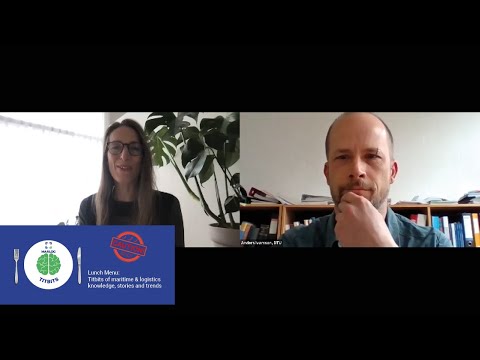
Green marine fuels in your engine
I this video, Associate Professor Anders Ivarsson (DTU Mechanical Engineering) present the current status of their projects and experimental capabilities in the field of green marine fuels (lignin fuel, ammonia, and dimethyl ether) in their combustion engine laboratory.
The session was developed in collaboration with MARLOG.