Find maritime knowledge
Knowledge
Keyword: shipping logistics
An investigation of forecast horizon and observation fit’s influence on an econometric rate forecast model in the liner shipping industry
This paper evaluates the influence of forecast horizon and observation fit on the robustness and performance of a specific freight rate forecast model used in the liner shipping industry. In the first stage of the research, a forecast model used to predict container freight rate development is presented by exploring the relationship between individual company’s rates and aggregated market rates, and thus assists in dealing with uncertainty and market volatility for a given business situation. In the second stage, a design of experiment approach is applied to highlight the influence of the forecast horizon and observation fit and their interactions on the forecast model’s performance. The results underline the complicated nature of creating a suitable forecast model by balancing business needs, a desire to fit a good model and achieve high accuracy. There is strong empirical evidence from this study; that a robust model is preferable, that overfitting is a true danger, and that a balance must be achieved between forecast horizon and the number of observations used to fit the model. In addition, methodological guidance has also been provided on how to test, design, and choose the superior model for business needs.
An RCM approach for assessing reliability challenges and maintenance needs of unmanned cargo ships
Unmanned autonomous cargo ships may change the maritime industry, but there are issues regarding reliability and maintenance of machinery equipment that are yet to be solved. This article examines the applicability of the Reliability Centred Maintenance (RCM) method for assessing maintenance needs and reliability issues on unmanned cargo ships. The analysis shows that the RCM method is generally applicable to the examination of reliability and maintenance issues on unmanned ships, but there are also important limitations. The RCM method lacks a systematic process for evaluating the effects of preventive versus corrective maintenance measures. The method also lacks a procedure to ensure that the effect of the length of the unmanned voyage in the development of potential failures in machinery systems is included. Amendments to the RCM method are proposed to address these limitations, and the amended method is used to analyse a machinery system for two operational situations: one where the vessel is conventionally manned and one where it is unmanned. There are minor differences in the probability of failures between manned and unmanned operation, but the major challenge relating to risk and reliability of unmanned cargo ships is the severely restricted possibilities for performing corrective maintenance actions at sea.
Arctic Port Development
Melting Arctic sea ice, shore ice, and permafrost are changing costs and benefits to transport routes between Atlantic and Pacific oceans, and more generally, for maritime economic activity in the Arctic. We investigate the potential for development of Arctic ports from a logistics (demand) and an infrastructural (supply) point of view that directly incorporates local concerns. This approach broadens the scope of the discussion from existing analyses that focus primarily on the ways in which global forces, exerted through resource extraction or trans-polar shipping, impact the Arctic.
Arctic Shipping and Risks: Emergency Categories and Response Capacities
The sea ice in the Arctic has shrunk significantly in the last decades. The transport pattern has as a result partly changed with more traffic in remote areas. This change may influence on the risk pattern. The critical factors are harsh weather, ice conditions, remoteness and vulnerability of nature. In this paper, we look into the risk of accidents in Atlantic Arctic based on previous ship accidents and the changes in maritime activity. The risk has to be assessed to ensure a proper level of emergency response. The consequences of incidents depend on the incident type, scale and location. As accidents are rare, there are limited statistics available for Arctic maritime accidents. Hence, this study offers a qualitative analysis and an expert-based risk assessment. Implications for the emergency preparedness system of the Arctic region are discussed.
Arctic Shipping: Commercial Opportunities and Challenges
This report forms part of the ambitious CBS Maritime research initiative entitled “Competitive Challenges and Strategic Development Potential in Global Maritime Industries” which was launched with the generous support of the Danish Maritime Fund. The competitiveness initiative targets specific maritime industries (including shipping, offshore energy, ports, and maritime service and equipment suppliers) as well as addresses topics that cut across maritime industries (regulation and competitiveness). The topics and narrower research questions addressed in the initiative were developed in close dialogue between CBS Maritime and the maritime industries in Denmark. CBS Maritime is a Business in Society (BiS) Platform at Copenhagen Business School committed to the big question of how to achieve economic and social progress in the maritime industries. CBS Maritime aims to strengthen a maritime focus at CBS and create the foundation for CBS as a stronger partner for the maritime industries, as well as for other universities and business school with a devotion to maritime economics research. The competitiveness initiative comprises a number of PhD projects and five short term mapping projects, the latter aiming at developing key concepts and building up a basic industry knowledge base for further development of CBS Maritime research and teaching. This report attempts to map the opportunities and challenges for the maritime industry in an increasingly accessible Arctic Ocean
Assessment of added resistance estimates based on monitoring data from a fleet of container vessels
A practical estimation methodology of the mean added resistance in irregular waves is shown, and the present paper provides statistical analyses of estimates for ships in actual conditions. The study merges telemetry data of more than 200 in-service container vessels with ocean re-analysis data from ERA5. Theoretical estimates relying on spectral calculations of added resistance are made for both long- and short-crested waves and are based on a combination of a parametric expression for the wave spectrum and a semi-empirical formula for the added resistance transfer function. The theoretical estimates are compared to predictions from an indirect calculation of added resistance relying on shaft power measurements and empirical estimates of the remaining resistance components. Overall, the comparison reveals a bias in bow oblique waves and higher sea states of the spectral estimates as well as the large variance of the empirically derived predictions — particularly in beam-to-following waves. One of the study’s main findings, confirming previous studies but based on a much larger dataset than in earlier similar studies, is that added resistance assessment based on in-service data is complex due to significant associated uncertainties.
At få sjælen med: En narrativ analyse af danske containersøfolks erindringer, fortidsbrug og identitetskonstruktioner
Containerfartens historiske udvikling bliver i litteraturen beskrevet som en revolution og en transformation af den internationale shippingbranche. De teknologiske og organisatoriske forandringer af livet til søs som fulgte med containerfarten har tilsvarende medført en forandring af maritime kulturer og en udfordring af de søfarendes identiteter.
Denne afhandling handler om danske containersøfolks erindringer, fortidsbrug og identitetskonstruktioner og undersøger, hvordan søfolkene fortæller sig selv i relation til deres levede erfaringer i containerfarten. Jeg analyserer i afhandlingen søfolkenes retrospektive fortidsfortolkninger som en måde at nærme mig en forståelse af de forandrede sømandsidentiteter.
Analytisk anlægger afhandlingen et subjektperspektiv, som anser fortiden for nærværende og åben i de mundtlige fortællingers fortolkninger og meningsforhandlinger af fortidens erfaringer. Jeg anskuer den narrative konstruktion af den personlige, autobiografiske, historie som identitetsdannende fortidsbrug, der udtrykker fortællerens subjektivitet. Med en erindringshistorisk tilgang til søfolkenes mundtlige fortællinger undersøger jeg, hvordan vi mennesker forstår os selv gennem de historier, vi fortæller om os selv.
Afhandlingen bygger empirisk på en række dybdegående oral history interviews med danske søfolk, der alle har erfaring inden for den internationale containerfart.
I afhandlingens analyser, viser jeg, hvordan søfolkene retfærdiggør og legitimerer deres valg om i første omgang at blive søfolk og senere at arbejde ombord på containerskibe. Jeg viser, hvordan søfolkene narrativt forhandler forskellige former for erfaret meningstab og aktivt tilskriver arbejdet og fællesskabet ombord på skibene en ny og brugbar mening. Jeg viser samtidig, hvordan den personlige historie konstrueres i dialog med kulturelt dominerende forestillinger og fortællinger. Sådanne forestillinger og fortællinger tilbyder den enkelte fortæller et tilgængeligt sprog at udtrykke sine personlige erfaringer i, men kan også virke begrænsende, hvis fortællerens erfaringer og forståelser ikke passer ind i de dominerende billeder. I sådanne tilfælde kan der opstå, hvad afhandlingen kalder en form for narrativt ubehag (discomposure), der kommer til udtryk som frustration og brud i fortællingens narrative sammenhæng.
Som en gennemgående metodisk pointe viser afhandlingen, hvordan interviewets intersubjektivitet er med til at forme den historie, som fortælles. Det personlige møde mellem fortæller og historiker og interviewets kulturelle kontekster indvirker på forskellig vis på den konstruerede historie. Fremfor at hævde en neutral og objektiv interviewsituation, tager afhandlingen i stedet konsekvensen af denne intersubjektivitet og skriver det konkrete møde mellem søfolkene som fortællere og mig som interviewer ind som en integreret del af den historiske fremstilling. Dette er både et narrativt greb og et metodisk valg, der skal sikre transparens ved at give læseren indblik i, hvordan historierne og mine tolkninger er blevet til.
Afhandlingen yder med sin tilgang og sine analyser flere bidrag til den eksisterende litteratur. Gennem de personlige fortællinger får vi større indsigt i søfolkenes levede liv og deres erfaringer med containerfartens historiske udvikling. Afhandlingen giver et menneskeligt perspektiv på historien om den internationale containerfart, der bidrager til vores viden om udviklingens identitetsmæssige betydning for de mænd og kvinder, som gennemlevede de historiske forandringer ude ombord på skibene.
Afhandlingen er en virksomhedshistorie, der tager oral history alvorligt både som forskningsfelt, metode og genre. Afhandlingen bidrager med sin erindringshistoriske tilgang til oral history til den fornyede samtale mellem forskningsfelterne oral history og virksomhedshistorie. Afhandlingen bringer metodiske og teoretiske indsigter fra den erindringshistoriske tradition ind i virksomhedshistorie og viser gennem sin egen narrative stil potentialet i en historieformidling, der sætter subjektivitet og erindring i centrum af sin analyse. Dermed bidrager afhandlingen også til den narrative vending inden for virksomhedshistorie ved ikke kun at anlægge et narrativt blik på de danske søfolks fortællinger men ved også at tage sig selv alvorligt som narrativ konstruktion.
Automated recognition and length estimation of fish on fishing vessels
Cod stocks in the Danish inland waters and the Baltic Sea have collapsed today. Fishing vessels have therefore been required to install video cameras that film the catch for control purposes. The use of artificial intelligence for automated documentation of the catch is therefore a promising solution for control as well as research and management purposes that can contribute to rebuilding cod stocks and ensuring sustainable fishing in the future.
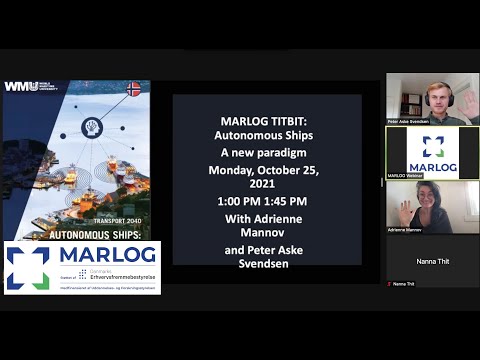
Autonomous Ships: A new paradigm for Norwegian shipping
In this webinar, Adrienne Mannov from Aarhus University and Peter Aske Svendsen from NFA presented their research on autonomous shipping as this relates to seafaring and technology, based on their 2019 report, “Transport 2040: Autonomous ships: A new paradigm for Norwegian shipping - Technology and transformation”.
The event was organized in collaboration with MARLOG
Blockchain in the maritime sector
The publication reports on a study of blockchain in the maritime sector with a focus on three value chains, namely container transport, fishing and processing of fish and shellfish, and plastic recycling. The publication describes different ways of using blockchain in the form of different types of companies, and with this as a starting point, the publication discusses the prerequisites for blockchain to be used in the analyzed value chains.