Find maritime knowledge
Knowledge
Keyword: shipping logistics
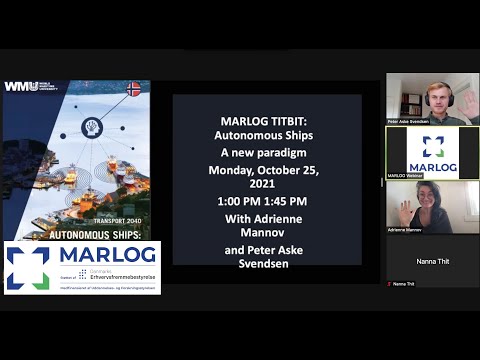
Autonomous Ships: A new paradigm for Norwegian shipping
In this webinar, Adrienne Mannov from Aarhus University and Peter Aske Svendsen from NFA presented their research on autonomous shipping as this relates to seafaring and technology, based on their 2019 report, “Transport 2040: Autonomous ships: A new paradigm for Norwegian shipping - Technology and transformation”.
The event was organized in collaboration with MARLOG
A representative model and benchmark suite for the container stowage planning problem
Due to limited access to domain knowledge and domain-relevant benchmark data, the Container Stowage Planning Problem (CSPP) is notably under-researched. In particular, previous models of the CSPP have lacked two key aspects of the problem: lashing forces and paired block stowage. The former may reduce vessel capacity by up to 10%, and the latter is NP-hard. The Representative CSPP (RCSPP), which captures all critical aspects of the problem is formulated. The presented RCSPP incorporates overlooked constraints such as paired block stowage and lashing, along with an innovative method for estimating lashing forces, all while maintaining simplicity. A heuristic method, STOW, has been developed to identify solutions for the RCSPP using a specially designed benchmark suite based on real-world scenarios. STOW algorithm is an advanced search heuristic employing a diverse range of solution modification strategies, each tailored to address specific aspects of stowage optimization. Feasible solutions were successfully identified for all instances within the benchmark suite. Our initial findings emphasize the importance of accurately modeling lashing forces and employing paired block stowage. Results show that removing the lashing constraint can increase the number of containers stowed by over 7% on average, while disabling paired block stowage can result in nearly a 5% increase.
A representative model and benchmark suite for the container stowage planning problem
Due to limited access to domain knowledge and domain-relevant benchmark data, the Container Stowage Planning Problem (CSPP) is notably under-researched. In particular, previous models of the CSPP have lacked two key aspects of the problem: lashing forces and paired block stowage. The former may reduce vessel capacity by up to 10%, and the latter is NP-hard. The Representative CSPP (RCSPP), which captures all critical aspects of the problem is formulated. The presented RCSPP incorporates overlooked constraints such as paired block stowage and lashing, along with an innovative method for estimating lashing forces, all while maintaining simplicity. A heuristic method, STOW, has been developed to identify solutions for the RCSPP using a specially designed benchmark suite based on real-world scenarios. STOW algorithm is an advanced search heuristic employing a diverse range of solution modification strategies, each tailored to address specific aspects of stowage optimization. Feasible solutions were successfully identified for all instances within the benchmark suite. Our initial findings emphasize the importance of accurately modeling lashing forces and employing paired block stowage. Results show that removing the lashing constraint can increase the number of containers stowed by over 7% on average, while disabling paired block stowage can result in nearly a 5% increase.
Uncertainty, status-based homophily, versatility, repeat exchange and social exchange in the container shipping industry
In this paper, we contribute to the literature on uncertainty and the drivers of social exchange. We explore the 2008 financial crisis and hand-collect unique data on more than 2,700 vessel chartering deals closed in the container shipping industry from 2000 to 2011. Our contribution is twofold. We challenge the literature by finding that low and high status players use different collaborative strategies under uncertainty: the high status players are more prone to coopetition and the low status ones reach out to external buyers. We also extend the literature on social exchange and uncertainty and introduce other constructs: strategic versatility and country-level long-term orientation of the suppliers that we study in our model. Our findings are relevant for policy and managerial decision-makers in the industry.
A rich model for the tramp ship routing and scheduling problem—Solved through column generation
We consider the Tramp Ship Routing and Scheduling Problem (TSRSP) in which we plan routes for a fleet of tramp shipping vessels operating on a combined contract and spot market. Earlier research has been fragmented due to variations in the side constraints studied. Hence we present the first unified model that can handle speed optimization, chartering costs, bunker planning, and hull cleaning. The model is solved by column generation, where the columns represent the possible routes of a vessel, while the master problem keeps track of the binding constraints. The pricing problem is solved efficiently using a time–space graph and several dominance rules. Real-life instances with up to 40 vessels, 35 geographic regions, and four months planning horizon can be solved to optimality in less than half an hour. The optimized routes increase earnings by 7% compared to historical schedules. Furthermore, policy-makers can use the model as a simulation of a rational agent behavior.
A rich model for the tramp ship routing and scheduling problem—Solved through column generation
We consider the Tramp Ship Routing and Scheduling Problem (TSRSP) in which we plan routes for a fleet of tramp shipping vessels operating on a combined contract and spot market. Earlier research has been fragmented due to variations in the side constraints studied. Hence we present the first unified model that can handle speed optimization, chartering costs, bunker planning, and hull cleaning. The model is solved by column generation, where the columns represent the possible routes of a vessel, while the master problem keeps track of the binding constraints. The pricing problem is solved efficiently using a time–space graph and several dominance rules. Real-life instances with up to 40 vessels, 35 geographic regions, and four months planning horizon can be solved to optimality in less than half an hour. The optimized routes increase earnings by 7% compared to historical schedules. Furthermore, policy-makers can use the model as a simulation of a rational agent behavior.
Systemic coordination of organizational roles: The importance of relational capital in port governance
Modern ports face not only a paradox of combining efficiency and effectiveness, but also a paradox of balancing activities characterized by different time horizons and stakeholder expectations. The structural changes underlying these paradoxes are the co-existence of downward pressures on market premiums and the increasing demands on the relational capabilities of port authorities. The increasing demand on relational capabilities is caused by the fact that modern ports are hubs for industrial activities that span the organizational boundaries of firms, integrating port systems and the hinterland. Thus, port authorities must simultaneously focus on cost efficiency and systemic coordination within complex port systems. As indicated by recent research on port governance and competitiveness, this implies that port authorities must assume and combine different organizational roles. The present paper takes this discussion further by classifying the organizational roles of port authorities in terms of role complexity, relational capital, and systemic functions within the port system. Based on a case study, the paper shows that the use of systemic functions implies the development of new business models, and that the adoption of the roles by port authorities depends on how emerging relational capabilities are embedded in structures of value co-creation and value co-capture.
Blockchain in the maritime sector
The publication reports on a study of blockchain in the maritime sector with a focus on three value chains, namely container transport, fishing and processing of fish and shellfish, and plastic recycling. The publication describes different ways of using blockchain in the form of different types of companies, and with this as a starting point, the publication discusses the prerequisites for blockchain to be used in the analyzed value chains.
Voluntary reporting in decarbonizing container shipping: The clean cargo case
Led by the UN’s International Maritime Organization (IMO) and the EU, the shipping industry struggles to reduce its greenhouse gas (GHG) emissions to align with the Paris Agreement. Clean Cargo, the leading voluntary buyer–supplier forum for sustainability in the cargo shipping industry, developed some years ago a methodology to calculate and report the GHG emissions from containerships. The recently introduced carbon emission requirements by the IMO and EU have reinforced the members’ interest in a new Clean Cargo reporting mechanism that enables a more effective and efficient monitoring of the decarbonization progress. A better understanding of the user needs accompanied by due consideration to the regulatory environment and the technological advances are key to build this new framework. This paper builds on the case of the Clean Cargo initiative to (1) identify the stakeholders’ expectations and motivations for voluntary disclosure of environmental information, and (2) discuss the governance challenges of voluntary initiatives. A questionnaire was designed and deployed to investigate the current uses of Clean Cargo data and the information sharing among different stakeholders. Voluntary schemes can speed up the decarbonization process by proposing standards accepted by all actors of the global value chain. Clean Cargo members envision reporting on absolute GHG emissions per shipment as the way forward.
Operational cycles for maritime transportation: Consolidated methodology and assessments
Operational cycles for maritime transportation is a new concept to improve the assessment of ships’ energy efficiency and offer benchmarking options among similar ship types and sizes. This work extends previous research to consolidate the methodology, bring more comprehensiveness, and provide a more holistic assessment of these operational cycles. The cycles are designed from noon reports from a fleet of around 300 container ships divided into eight size groups. The comparison between cycles derived from speed and draft with those based on main engine power identifies that the cycles based on speed and draft are more accurate and allow for estimating the Energy Efficiency Operational Index but require more data. The main-engine-power cycles are more effective in benchmarking through the Annual Efficiency Ratio. These cycles reduce the inherent variability of the carbon intensity indicator and present good opportunities as a benchmarking tool for strengthening the regulatory framework of international shipping.