Find maritime knowledge
Knowledge
Keyword: innovation
Anticipated innovations for the blue economy: Crowdsourced predictions for the North Sea Region
The mission policy approach to the sustainable blue economy has identified as critical the ability to anticipate the emergence of a wide range of feasible innovations as they enter the transactional environment of organizations in the marine and maritime sector. This article contributes to that growing effort by harnessing the wisdom of the crowd and presents more than 60 crowdsourced, time-specific innovation forecasts expected to impact maritime, shipbuilding, ports, offshore wind, and ocean infrastructure. Data were collected in 2020 by the EU-funded Interreg VB PERISCOPE Project, a North Sea Region initiative to catalyze transregional innovation. The results can be used strategically to develop collaborative, transregional planning and policy for innovation based on data reflecting public expectations for the future. Years from now, this article can also act as a snapshot of public expectations at the onset of the decade.
Facilitating Large-Amplitude Motions of Wave Energy Converters in OpenFOAM by a Modified Mesh Morphing Approach
High-fidelity simulations using computational fluid dynamics (CFD) for wave-body interaction are becoming increasingly common and important for wave energy converter (WEC) design. The open source finite volume toolbox OpenFOAM® is one of the most frequently used platforms for wave energy. There are currently two ways to account for moving bodies in OpenFOAM: (i) mesh morph-ing, where the mesh deforms around the body; and (ii) an overlooked mesh method where a separate body mesh moves on top of a background mesh. Mesh morphing is computationally efficient but may introduce highly deformed cells for combinations of large translational and rotational motions. The overlooked method allows for arbitrarily large body motions and retains the quality of the mesh. However, it comes with a substantial increase in computational cost and possible loss of energy conservation due to the interpolation. In this paper we present a straightforward extension of the spherical linear interpolation (SLERP) based mesh morphing algorithm that increases the stability range of the method. The mesh deformation is allowed to be interpolated independently for different modes of motion, which facilitates tailored mesh motion simulations. The paper details the implementation of the method and evaluates its performance with computational examples of a cylinder with a moonpool. The examples show that the modified mesh morphing approach handles large motions well and provides a cost effective alternative to overlooked mesh for survival conditions.
Creating Circular Economy Clusters for Sustainable Ship Recycling in Denmark
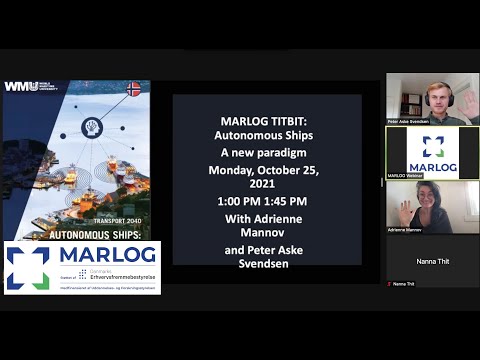
Autonomous Ships: A new paradigm for Norwegian shipping
In this webinar, Adrienne Mannov from Aarhus University and Peter Aske Svendsen from NFA presented their research on autonomous shipping as this relates to seafaring and technology, based on their 2019 report, “Transport 2040: Autonomous ships: A new paradigm for Norwegian shipping - Technology and transformation”.
The event was organized in collaboration with MARLOG
The Energy Islands: A Mars Mission for the Energy system
Denmark has set ambitious targets, to reduce emission with 70% by 2030 and become independent of fossil fuels by 2050. To achieve those targets, Denmark is planning to accelerate the de-carbonization of the power system, by replacing fossil fuel generation plants with renewable energy sources (RES). Offshore wind power will form the backbone of power generation in a decarbonized system. Already world leading in electric consumption share covered by wind power, Denmark plans to install an additional 6.8 GW of offshore wind by 2030, quadrupling the 1.7 GW already connected to the system.

The future of Blue Economies
In this video, Matthew Spaniol (Aarhus University) presents the interim results from the Interreg vb North Sea PERISCOPE project, a foresight study that involved scanning the horizon from the bird’s nest to identify the innovations that will impact the blue economies in the future, and the accompanying forecasting results that timestamp when in the future the innovations are expected to become commercially available. The session was developed in collaboration with MARLOG.
Åben Innovation i Det Blå Danmark. På trods af DNA og NDA
Multi-Phase Flow Metering in Offshore Oil and Gas Transportation Pipelines: Trends and Perspectives
Multi-phase flow meters are of huge importance to the offshore oil and gas industry. Unreliable measurements can lead to many disadvantages and even wrong decision-making. It is especially important for mature reservoirs as the gas volume fraction and water cut is increasing during the lifetime of a well. Hence, it is essential to accurately monitor the multi-phase flow of oil, water and gas inside the transportation pipelines. The objective of this review paper is to present the current trends and technologies within multi-phase flow measurements and to introduce the most promising methods based on parameters such as accuracy, footprint, safety, maintenance and calibration. Typical meters, such as tomography, gamma densitometry and virtual flow meters are described and compared based on their performance with respect to multi-phase flow measurements. Both experimental prototypes and commercial solutions are presented and evaluated. For a non-intrusive, non-invasive and inexpensive meter solution, this review paper predicts a progress for virtual flow meters in the near future. The application of multi-phase flows meters are expected to further expand in the future as fields are maturing, thus, efficient utilization of existing fields are in focus, to decide if a field is still financially profitable.
Into the sea: capacity-building innovations and the maritime security challenge
Maritime security capacity-building is a growing field of international activity. It is an area that requires further study, as a field in its own right, but also as an archetype to develop insights for capacity-building and security sector reform in other arenas. This article is one of the first to analyse this field of activity. Our empirical focus is on the Western Indian Ocean (WIO) region. Here, international actors have launched multiple capacity-building projects, initially in response to Somali piracy. We document the significance, extent and variety of capacity-building activities in this region and examine the ways in which capacity-building at sea has incorporated innovative characteristics that develop and expand the capacity-building agenda as traditionally understood. Our conclusion highlights the need to pay more attention to the maritime domain in international security and development studies and considers ways in which the maritime capacity-building experience may offer important lessons for other fields of international policy.
Reviewing the challenges of port authority business model innovation
The port industry is in a state of flux which is affecting the roles of port authorities. Applying a business model perspective to explore this qualitative shift in competition, this paper argues that port authorities are increasingly managing multiple multilateral business models. This is analyzed through an integrative review of port research which identifies four challenges for port authorities: 1) diversification of port customers; 2) requirements for new value creation; 3) changing possibilities and constraints of value capture; and 4) network effects, clusters and strategic partnerships. The review contributes to literature by exploring how managing port authority business model innovation requires changing the underlying business logic, the activities and resources and the configurational fit with other port actors' business models. This proposition is based on the interplay between the macro level port industry, the meso level rule structures within port systems and the micro level of port authority organisations.