Find maritime knowledge
Knowledge
Keyword: innovation
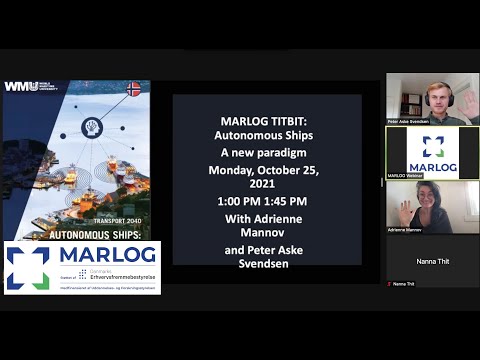
Autonomous Ships: A new paradigm for Norwegian shipping
In this webinar, Adrienne Mannov from Aarhus University and Peter Aske Svendsen from NFA presented their research on autonomous shipping as this relates to seafaring and technology, based on their 2019 report, “Transport 2040: Autonomous ships: A new paradigm for Norwegian shipping - Technology and transformation”.
The event was organized in collaboration with MARLOG
Systemic coordination of organizational roles: The importance of relational capital in port governance
Modern ports face not only a paradox of combining efficiency and effectiveness, but also a paradox of balancing activities characterized by different time horizons and stakeholder expectations. The structural changes underlying these paradoxes are the co-existence of downward pressures on market premiums and the increasing demands on the relational capabilities of port authorities. The increasing demand on relational capabilities is caused by the fact that modern ports are hubs for industrial activities that span the organizational boundaries of firms, integrating port systems and the hinterland. Thus, port authorities must simultaneously focus on cost efficiency and systemic coordination within complex port systems. As indicated by recent research on port governance and competitiveness, this implies that port authorities must assume and combine different organizational roles. The present paper takes this discussion further by classifying the organizational roles of port authorities in terms of role complexity, relational capital, and systemic functions within the port system. Based on a case study, the paper shows that the use of systemic functions implies the development of new business models, and that the adoption of the roles by port authorities depends on how emerging relational capabilities are embedded in structures of value co-creation and value co-capture.
A stabilised nodal spectral element method for fully nonlinear water waves
We present an arbitrary-order spectral element method for general-purpose simulation of non-overturning water waves, described by fully nonlinear potential theory. The method can be viewed as a high-order extension of the classical finite element method proposed by Cai et al. (1998)[5], although the numerical implementation differs greatly. Features of the proposed spectral element method include: nodal Lagrange basis functions, a general quadrature-free approach and gradient recovery using global L2projections. The quartic nonlinear terms present in the Zakharov form of the free surface conditions can cause severe aliasing problems and consequently numerical instability for marginally resolved or very steep waves. We show how the scheme can be stabilised through a combination of over-integration of the Galerkin projections and a mild spectral filtering on a per element basis. This effectively removes any aliasing driven instabilities while retaining the high-order accuracy of the numerical scheme. The additional computational cost of the over-integration is found insignificant compared to the cost of solving the Laplace problem. The model is applied to several benchmark cases in two dimensions. The results confirm the high order accuracy of the model (exponential convergence), and demonstrate the potential for accuracy and speedup. The results of numerical experiments are in excellent agreement with both analytical and experimental results for strongly nonlinear and irregular dispersive wave propagation. The benefit of using a high-order – possibly adapted – spatial discretisation for accurate water wave propagation over long times and distances is particularly attractive for marine hydrodynamics applications.
ADVANTAGES AND LIMITATIONS OF USING CAMERAS ON SMALL, LOW-COST ROVS FOR SEABED MONITORING
Monitoring methods, such as seabed bottom-towed cameras, sediment grabs, and benthic sledges, have limitations in spatial coverage, cause seabed disturbance, are restricted to soft-bottom substrates, and offer low flexibility for marine seabed monitoring. In this study, we investigate the potential of a non-invasive and simple underwater remotely operated vehicle (ROV) to enhance marine seabed monitoring. A tethered ROV equipped with a GoPro camera was deployed in three areas of Skagerrak at depths from 15-34 m to assess accuracy in species identification and substrate classification identified from still frames. The quality of still frames varied between areas due to turbidity, motion blur, and marine snow, which reduced the number of high-quality frames by approximately 20%. Classification of substrates and taxa identification were possible in the remaining still frames. Two different substrates were detected: sand and stone reef. Stone reefs had a lower occurrence compared to sand. A total of 10 taxa were detected in the two substrate types. The highest abundance was observed in the stone reef substrate compared to the sand substrate. Identification at the species level was limited due to the quality of the still frames, which affected the detectability of morphological traits. This study demonstrates that a widely accessible ROV can be used for marine monitoring. The ROV can be used in different substrates, and still frames provide valuable information on species composition, which can enhance the replicability of monitoring programs.
Rethinking deindustrialization
Manufacturing in high-income countries is on the decline and Denmark is no exception. Manufacturing employment and the number of firms have been shrinking as a share of the total and in absolute levels. This paper uses a rich linked employer-employee dataset to examine this decline from 1994 to 2007. We propose a different approach to analyze deindustrialization and generate a series of novel stylized facts about the evolution. While most of the decline can be attributed to firm exit and reduced employment at surviving manufacturers, we document that a non-negligible portion is due to firms switching industries, from manufacturing to services. We focus on this last group of firms before, during, and after their sector switch. Overall this is a group of small, highly productive, import intensive firms that grow rapidly in terms of value-added and sales after they switch. By 2007, employment at these former manufacturers equals 8.7 percent of manufacturing employment, accounting for half the decline in manufacturing employment. We focus on the composition of the workforce as firms make their transition. In addition, we identify two types of switchers: one group resembles traditional wholesalers and another group that retains and expands their R&D and technical capabilities. Our findings emphasize that the focus on employment at manufacturing firms overstates the loss in manufacturing-related capabilities that are actually retained in many firms that switch industries.
Into the sea: capacity-building innovations and the maritime security challenge
Maritime security capacity-building is a growing field of international activity. It is an area that requires further study, as a field in its own right, but also as an archetype to develop insights for capacity-building and security sector reform in other arenas. This article is one of the first to analyse this field of activity. Our empirical focus is on the Western Indian Ocean (WIO) region. Here, international actors have launched multiple capacity-building projects, initially in response to Somali piracy. We document the significance, extent and variety of capacity-building activities in this region and examine the ways in which capacity-building at sea has incorporated innovative characteristics that develop and expand the capacity-building agenda as traditionally understood. Our conclusion highlights the need to pay more attention to the maritime domain in international security and development studies and considers ways in which the maritime capacity-building experience may offer important lessons for other fields of international policy.
High-fidelity modelling of moored marine structures: multi-component simulations and fluid-mooring coupling
High-fidelity viscous computational fluid dynamics (CFD) models coupled to dynamic mooring models is becoming an established tool for marine wave-body-mooring (WBM) interaction problems. The CFD and the mooring solvers most often communicate by exchanging positions and mooring forces at the mooring fairleads. Mooring components such as submerged buoys and clump weights are usually not resolved in the CFD model, but are treated as Morison-type bodies. This paper presents two recent developments in high-fidelity WBM modelling: (i) a one-way fluid-mooring coupling that samples the CFD fluid kinematics to approximate drag and inertia forces in the mooring model; and (ii) support for inter-moored multibody simulations that can resolve fluid dynamics on a mooring component level. The developments are made in the high-order discontinuous Galerkin mooring solver MoodyCore, and in the two-phase incompressible Navier–Stokes finite volume solver OpenFOAM. The fluid-mooring coupling is verified with experimental tests of a mooring cable in steady current. It is also used to model the response of the slack-moored DeepCwind FOWT exposed to regular waves. Minor effects of fluid-mooring coupling were noted, as expected since this a mild wave case. The inter-mooring development is demonstrated on a point-absorbing WEC moored with a hybrid mooring system, fully resolved in CFD-MoodyCore. The WEC (including a quasi-linear PTO) and the submerged buoys are resolved in CFD, while the mooring dynamics include inter-mooring effects and the one-way sampling of the flow. The combined wave-body-mooring model is judged to be very complete and to cover most of the relevant effects for marine WBM problems.
Solution verification of WECs: comparison of methods to estimate numerical uncertainties in the OES wave energy modeling task
High-fidelity models become more and more used in the wave energy sector. They offer a fully nonlinear simulation tool that in theory should encompass all linear and nonlinear forces acting on a wave energy converter (WEC). Studies using high-fidelity models are usually focusing on validation of the model. However, a validated model does not necessarily provide reliable solutions. Solution verification is the methodology to estimate the numerical uncertainties related to a simulation. In this work we test four different approaches: the classical grid convergence index (GCI); a least-squares version (LS-GCI); a simplified version of the least-square method (SLS-GCI); and the ITTC recommended practice. The LS-GCI requires four or more solutions whereas the other three methods only need three solutions. We apply these methods to four different high-fidelity models for the case of a heaving sphere. We evaluate the numerical uncertainties for two parameters in the time domain and two parameters in the frequency domain. It was found that the GCI and ITTC were hard to use on the frequency domain parameters as they require monotonic convergence which sometimes does not happen due to the differences in the solutions being very small. The SLS-GCI performed almost as well as the SL-GCI method and will be further investigated.
Hybrid testing of a telescopic pump for pressurized water power-take off
Hybrid testing, often referred to as hardware-in-the-loop, is when some parts of a complete system are modeled virtually and some parts are modeled experimentally, with information flowing back-and-forth between the virtual and experimental parts. Hybrid testing speeds up prototyping and testing. In this paper we outline the hybrid set-up for testing the performance of a hydraulic pump which is used as part of the power take-off system of the Wavepiston multi-body floating oscillating wave surge converter (OWSC). The motion of the OWSC is modeled in Orcaflex and the hydraulic system is simulated using Simscape. Due to the long stroke-length of the telescopic pump, a test rig handling only 1/3 of the stroke-length was constructed. The co-simulation, and linking to the test rig, is done using the Model.CONNECTTM and Testbed.CONNECTTM framework by AVL. The results obtained can be used for improving the numerical representation of the pump and validating models for the wear of the seals inside the pump.
High-Fidelity Hydrodynamic Simulations of a Slack-Moored Floating Offshore Wind Turbine Platform
We numerically simulate the hydrodynamic response of a floating offshore wind turbine (FOWT) using computational fluid dynamics. The FOWT under consideration is a slack-moored 1:70 scale model of the UMaine VolturnUS-S semi-submersible platform. The test cases under consideration are (i) static equilibrium load cases, (ii) free decay tests, and (iii) two focused wave cases of different wave steepness. The FOWT is modeled using a two-phase Navier-Stokes solver inside the OpenFOAM-v2006 framework. The catenary mooring is computed by dynamically solving the equations of motion for an elastic cable using the MoodyCore solver. The results are shown to be in good agreement with measurements.