Evidence-Based Policymaking: The Role of Research in Multilateral Negotiations on Climate, Oceans, and Security
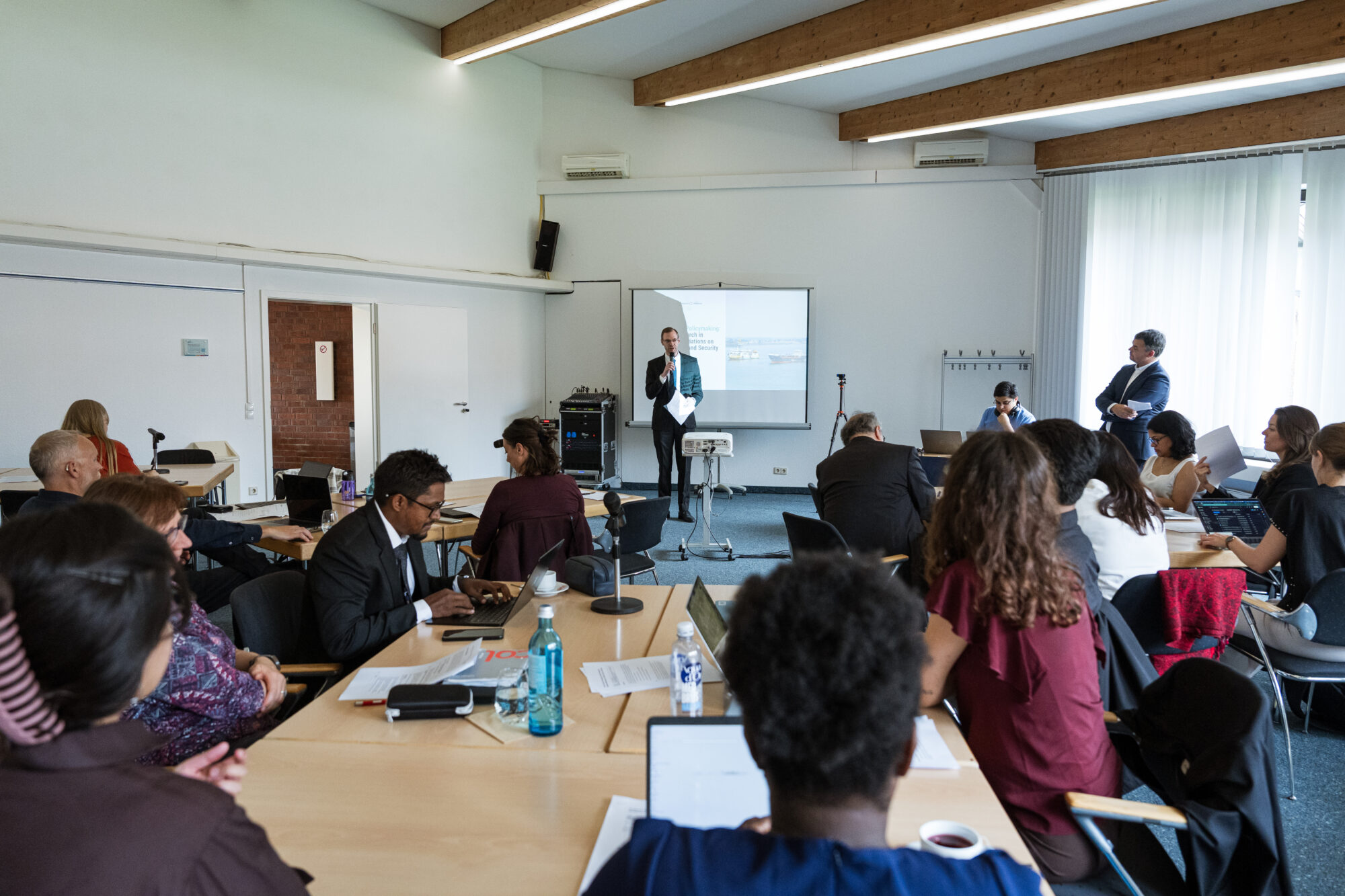
In August 2026, together with SLYCAN Trust (now Clima Trust), we hold a two day conference in Bonn on “Evidence-Based Policymaking: The Role of Research in Multilateral Negotiations on Climate, Oceans, and Security”. The event brought together researchers, policymakers, UN negotiators and NGOs to strengthen the science-policy collaboration in ocean governance, climate action, and maritime security.
Over two days, we discussed how research can better inform policymaking and how evidence can be translated into effective implementation across international and national processes. Central themes included ocean governance, climate change, maritime security, finance, technology, and decarbonisation.
The conference opened with an interactive panel on oceans, multilateral processes, and the role of evidences in multilateral negotiations. Discussions highlighted that the challenge is often not a lack of evidence, but the gap between knowledge and implementation. Speakers emphasised the importance of behavioural science, local contexts, capacity building, and understanding the costs of both action and inaction.
We also explored the growing connections between climate change and security, the role of finance and technology in supporting ocean sustainability, and the challenges of translating scientific evidence into concrete policy interventions. Discussions covered topics ranging from sea level rise and small island states to plastic pollution, maritime decarbonisation, and the governance of emerging climate and ocean finance mechanisms. In the evening, we discussed possible opportunity for integrating health into climate and ocean related processes.
On the second day, participants examined several thematic areas more in depth. Among the researcher in our network, Henrik Sornn-Friese from Copenhagen Business School highlighted the critical role of ports in shaping the future of decarbonisation, arguing that as the transition increasingly depends on land-based infrastructure and multiple energy systems, ports are becoming key hubs for coordinating actors, enabling innovation, and connecting to policy-making at multiple levels. Harshit _PhD from IT-Universitetet i København introduced us to the use of geospatial techniques to understand climate change and its impacts in different scenarios on land and at sea. Agnieszka Nowinska, PhD from Aalborg University explored how the growing use of AI and rising geopolitical tensions are reshaping cybersecurity risks in shipping, highlighting how digital attacks can escalate into physical disruptions with significant safety, environmental, and supply chain consequences. Michele Acciaro from Copenhagen Business School examined the intersection of climate action and maritime defence, highlighting how climate change and security agendas increasingly overlap through shared infrastructure, resources, and technologies, while also facing governance, funding, and implementation challenges.
The presentation were followed by breakout sessions. Across all discussions, several recurring themes emerged:
– The need to bridge the gap between scientific knowledge and policy implementation.
– Better communication of research findings to policymakers and the public.
– Stronger collaboration between academia, governments, international organisations, industry, and local communities.
– Greater attention to implementation, capacity building, and country-specific contexts.
– The importance of creating enduring platforms that connect research and policymaking.
The conference concluded with a shared recognition that addressing ocean, climate, and security challenges requires not only robust evidence, but also stronger mechanisms for translating knowledge into action. Building bridges between research and policy remains essential for achieving meaningful and lasting impact.
Thank you to all speakers and participants, for the insightful discussions and valuable exchanges over these two days. A special thanks to Vositha Wijenayake and Dennis Mombauer at SLYCAN Trust (now Clima Trust) for hosting the event.
We look forward to continuing the conversation and strengthening collaboration across research and policymaking!